
Watch the video Moving abroad to work. In some sentences write about the video. Navigate slide 75
The video was about Shujana, a student who lived and studied in the southeastern Hungary. Like a lot of people she has moved to Hungary (abroad) in order to find work. Now Shujana lives in London and shares with feelings about living abroad.
What did she do in Hungary? — She taught English and German in a secondary school.
Why did she move to England? — At that time Shujana felt that she needed a change of environment, and she wanted to test her skills. She wanted to know what can she achieve abroad, also.
Can she describe her current role? — At the moment she’s doing manual software testing. They test digital products of OUP. They have to make sure that everything works the way they’re supposed to.
Does she think moving to England has improved your career prospects? — She thinks that here career prospects have improved. Especially when she moves back to Hungary she can show that she knows English very fluent, that she lived abroad and etc. She doesn’t think that she would have been able to change jobs that easily in Hungary if she had stayed there, because there aren’t that many jobs available.
How difficult is to get a job in Hungary at the moment? — In Hungary the job situation is not the best at this time. There are quite a lot of people who move abroad mainly Germany, Austria, the UK.
What are the major differences between living in Hungary and England? — The major difference is the cost of living. In England everything is so expensive. Renting the flat on your own is almost impossible. In Hungary renting your own place is more affordable.
What about the differences in the way people work? — A typical working day in Hungary is eight hours plus lunch break. In England it’s usually seven and half hours plus lunch break. Working hours are a little bit longer than in the UK. In Hungary people start to work at 8.00 or 8.30 and in England the work starts at 9.00 or 9.30. Depends on the company that you’re working in.
Would she like to move back to Hungary? — She’s not sure, it depends how things work out in England.
How about in her career? What would she like to do in the future? — In the future she wants to develop as a software tester.
Navigate Review slide 76 ex-es 1a, 2a, 3a
ex. 1a
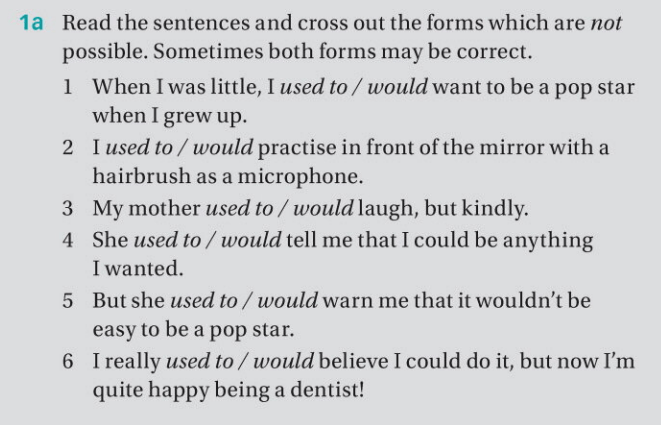
- When I was little, I used to want to be a pop star when I grew up.
- I used to practice in front of the mirror with a hairbrush as a microphone.
- My mother would laugh, but kindly.
- She would tell me that I could be anything I wanted.
- But she used to warn me that it wouldn’t be easy to be a pop star.
- I really used to believe I could do it, but now I’m quite happy being a dentist!
ex. 2a
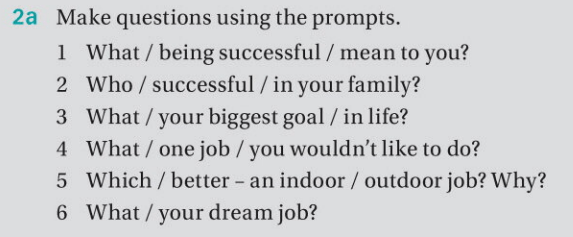
- What being successful means to you?
- Who is successful in your family?
- What is your biggest goal in life?
- What is one-job you wouldn’t like to do?
- Which is better an indoor or outdoor job? Why?
- What is your dream job?
ex. 3a
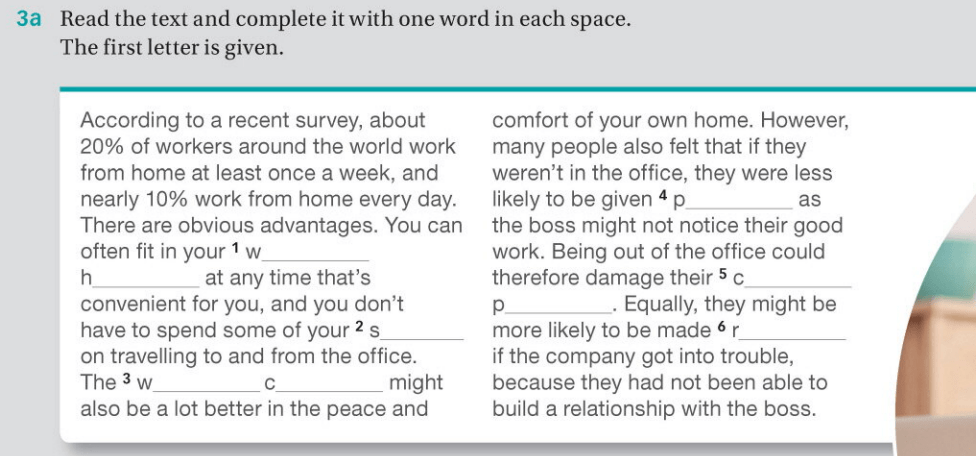
According to a recent survey, about 20% of workers around the world work from home at least once a week, and nearly 10% work from home every day. There are obvious advantages. You can often fit in your working hours at any time that’s convenient for you, and you don’t have to spend some of your salary on travelling to and from the office. The working conditions might also be a lot better in the peace and comfort of your own home. However, many people also felt that if they weren’t in the office, they were less likely to be given promotion as the boss might not notice their good work. Being out of the office could therefore damage their career prospects. Equally, they might be more likely yo be made redundant if the company got into trouble, because they had not been able to build a relationship with the boss.
 Դավիթ Մուրադյան