
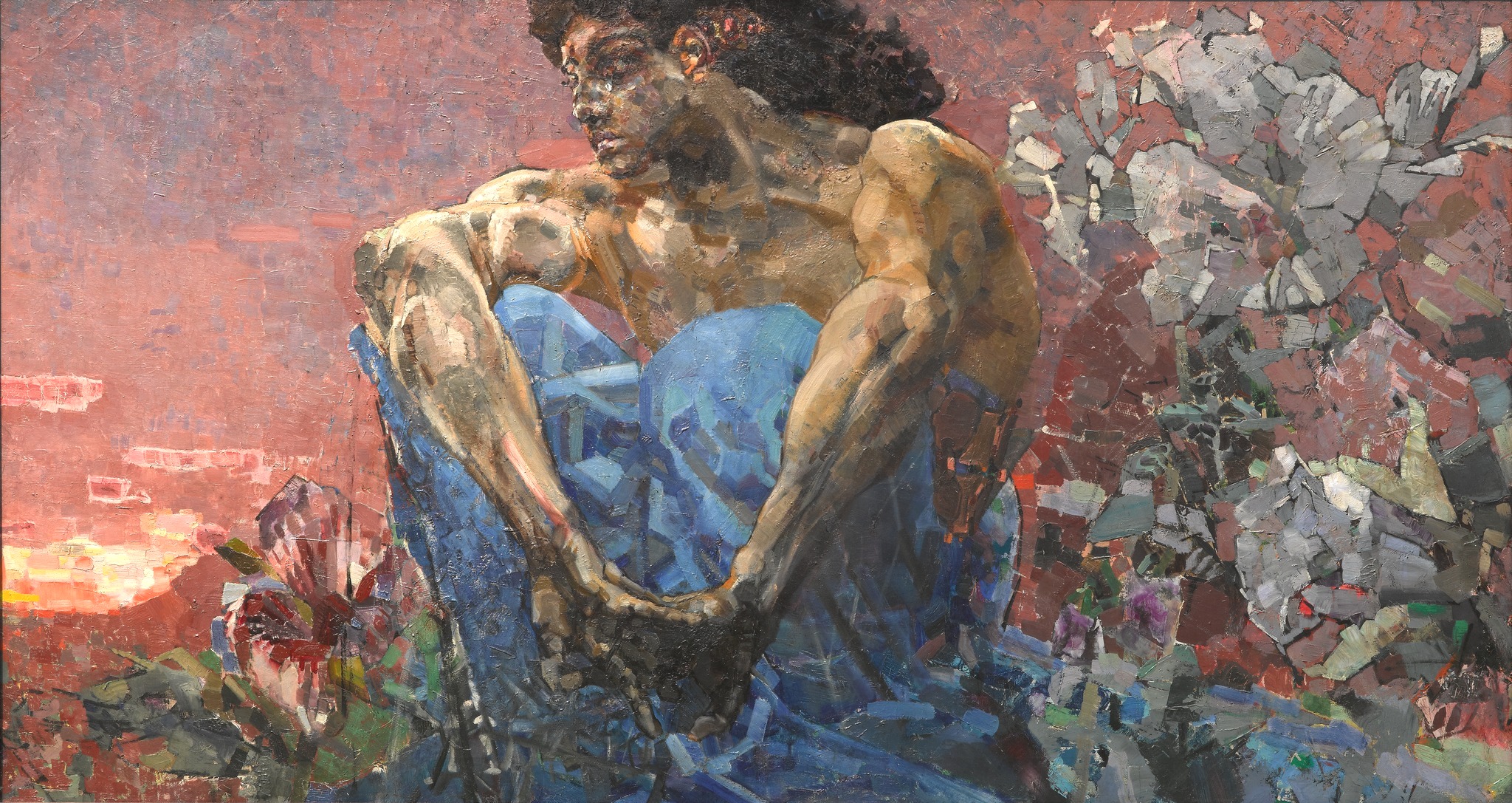
Background:
Not only the art, but also the whole life of this artist is eccentric and secret: unpredictable actions, unrequited love, mental disorder, fear, inner demons, criticism, hatred — these are still the smallest list of what the artist experienced on the way to universal recognition.
Mikhail Vrubel Alexandrov was born on March 17, 1856 in Omsk, in a military family, studied at the gymnasium, entered the Faculty of Law in Petersburg and did not even think about the career of an artist. It was only while studying at the university that young Vrubel became interested in literature, philosophy, and theater, and he began his search for his own meaning. At that time, he started drawing simple illustrations for books, was engaged in tutoring.
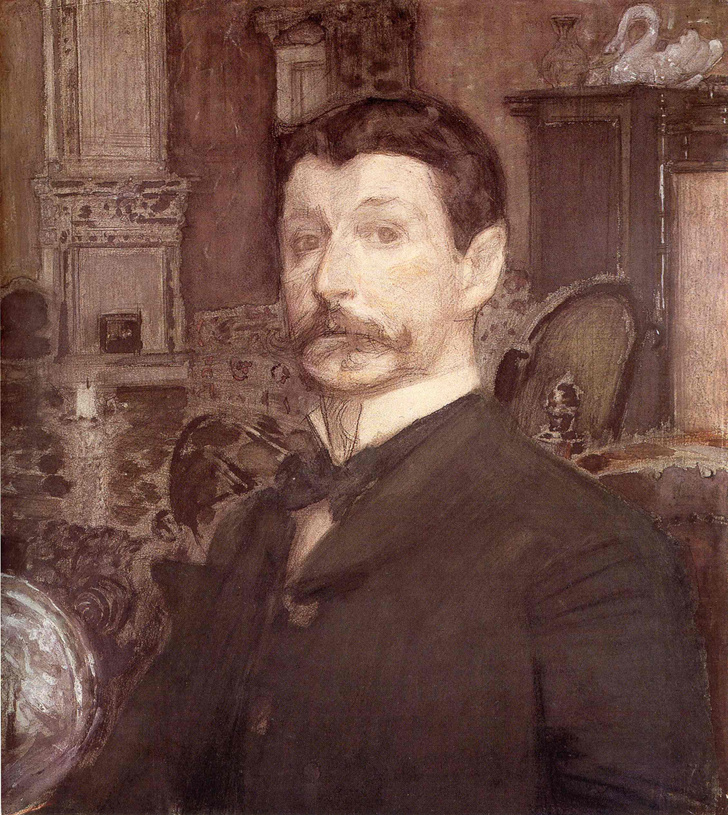
At the age of 24, Vrubel graduated from university and entered the St. Petersburg Academy of Arts as a student. In his letters to his sister Ekaterina, the artist called that period one of the best moments of his life and had a warm attitude towards his teacher, Pavel Chistyakov. Having gained experience at the academy, but not completing his studies, in 1883 Vrubel went to Kiev to work at the invitation of the famous archaeologist Adrian Prakhov.
The artist stayed in Kyiv for five years. He was engaged in restoration works in the Kirillovian Church and the Sophia Cathedral, led a lively social life, had a passionate love for his employer’s wife, and then a creative crisis.
Against the background of unrequited love, the artist went into himself, began to inflict physical injuries on himself and suffer from depression. It was during this period that Vrubel began one of his first works depicting the image of a demon. Vrubel’s father, who came to visit his son, seeing the unfinished painting, called it a demon sitting against the background of mountains, “evil and repulsive”. Vrubel did not continue the work and later, after his father’s departure, tired of mental suffering and creative stagnation, he decided to return to Moscow.
“Sitting Demon”
It was in the “Moscow region” that Vrubel was given the opportunity to fully depict his demons, which eventually became the main theme of his art and brought him fame.
It all started with the fact that in 1890 the artist was offered to make illustrations for M. Lermontov’s jubilee two-volume set. Although there were other illustrators working for the book, it was the black-and-white illustrations by the then-unknown Mikhail Vrubel that provoked a strong response from the public and critics. Some called his illustrations harsh and tasteless, others accused him of drawing caricatures, and still others found the demon simply ridiculous.

But the opinion of critics did not stop Vrubel, almost parallel to the illustrations of Lermontov’s poem, he began to work on the work “The Sitting Demon”. In his letters to his sister, the artist said, “I paint a demon, that is, not exactly a monumental demon, which I will write over time, but a “demonic” half-naked, winged, young, sad one. A pensive figure, kneeling, sits against a sunset background and looks out over a blossoming meadow, from which branches stretch towards him, bending beneath the flowers.’
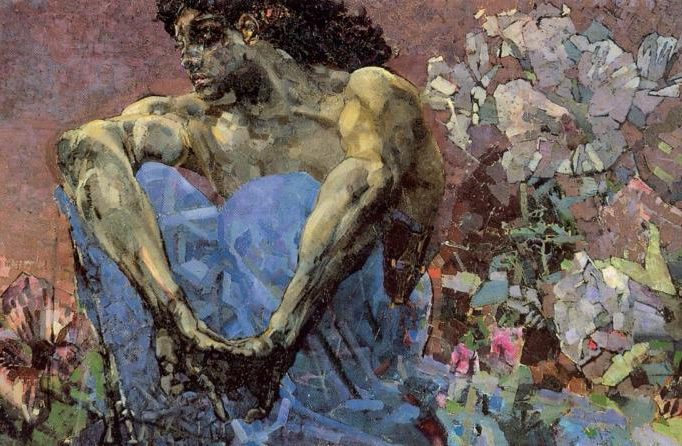
Indeed, in the picture we see not a demon, but a sensual and strong figure of a young man. The sad look is directed into the distance, the clenched fingers and the drooping head betray despair and longing, the sad eyes and the gaze directed somewhere into the distance show the human nature. It seems that Vrubel’s demon knew the simple joys of human life and does not find a place for himself. He lost his composure and began to wander for answers, for liberation.
Vrubel worked carefully on the image of the demon, constantly erasing some paint and applying others, correcting the position, facial expression and details. The artist worked out the background in an equally thorough manner. He collected photographs of mountain landscapes, studied each one, and tried to find the most suitable background for the grim figure of the seated demon. Behind the demon’s back you can see unusual flowers. they look like crystals of different shades and seem to turn the picture into one big gem. Vrubel adopted this technique of “crystal” painting from his teacher at the Art Academy P. Chistyakov. He applied the paint with a palette knife in smooth, broad and short strokes, creating a mosaic effect.
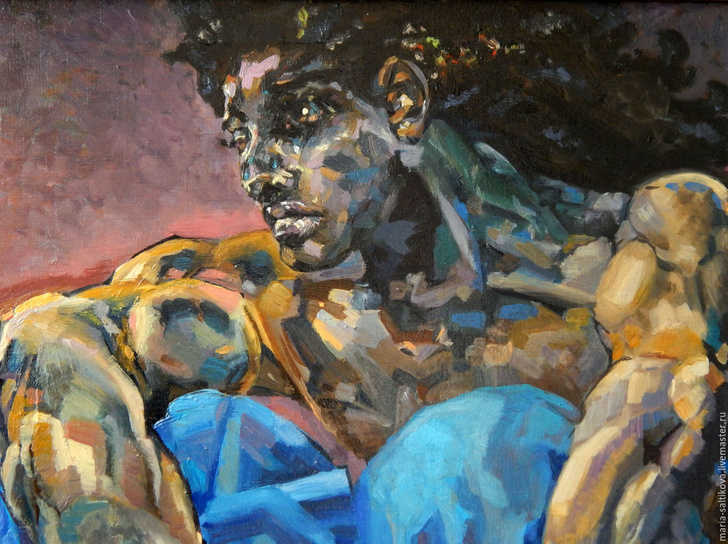
The author did not put evil and depravity in the character of the demon-young man, but longing, suffering and even exciting female features. He also spoke about this in his letter. “The demon is not so much an evil spirit as a suffering and lamentable, along with all this, a domineering, noble spirit. His whole appearance is full of power: a muscular body, large facial features and a strong willed chin, a powerful neck contrasted with huge sad eyes and a feminine sensual mouth.
The result is a work that amazes with its depth and mystery. People who get to know the “Sitting Demon” for the first time and do not know that before them is not an inherently evil character, even sympathize with him. And after reading the name, they are genuinely surprised and start looking for repulsive and opposite characteristics. This means that M. A. Vrubel was able to endow his hero with such contradictory and complex features that we were faced with a choice: sympathy or contempt, love or hate. But one way or another, the “demon’s” doubts and mental torments are transmitted to us, like his longing for a world where he could not find a place for himself.
Interesting facts
- Vrubel was not only a brilliant artist, but also engaged in arts and crafts. His works include sculpture, ceramic vases, stage sets and even architectural designs.
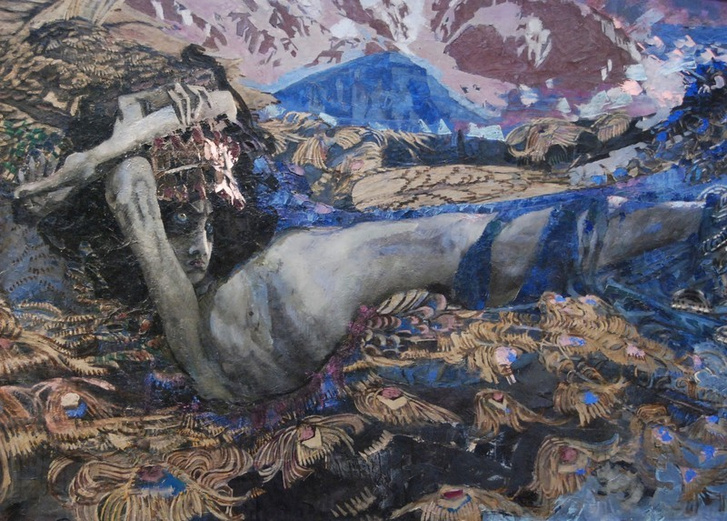
- Demons haunted the artist all his life. In 1899 he wrote “The Demon in Flight” and two years later “The Fallen Demon”. “The Covered Demon” is also in the Tretyakov Gallery, and the “Flying Demon” is in the Russian Museum in St. Petersburg.
- M. A. Vrubel was married to opera singer Nadezhda Zabela. Their only son, Savva, was born with a cleft lip, became very ill at the age of two and could not be saved. Vrubel managed to paint a large watercolor portrait of his six-month-old son in a stroller.
- M. Vrubel often corrected his pictures and sometimes even ruined them. When “The Covered Demon” participated in the exhibition, Vrubel came every morning, when there were few visitors, and erased some paints, applied others, endlessly correcting the background and the pose of the hero.
- The artist often suffered from depression and mental disorders. After his son’s illness and death, Vrubel was diagnosed with tertiary syphilis and manic-depressive psychosis. A long illness and treatment began in various clinics. In 1910 M. A. Vrubel died at the age of 54.

Translated from: https://www.elle.ru/stil-zhizni/vrubelkartinanakarantine/
 Դավիթ Մուրադյան