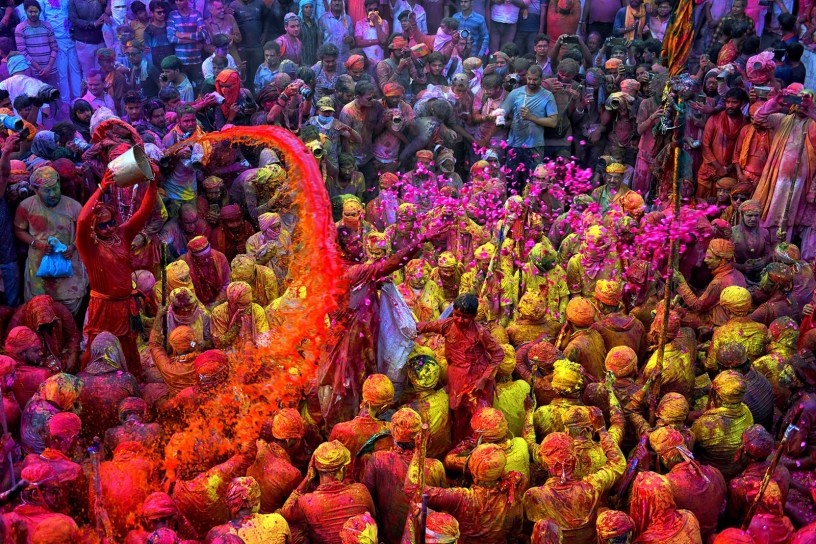
A Hindu celebration of the triumph of good over evil and the arrival of spring, Holi is catching on as a colored-powder-throwing party in many cultures beyond India. In fact, if you live in Boston, Houston, Chicago or a number of other major cities in the States, there may be a Holi Fest near you. This ancient tradition marks the end of winter and honors the triumph of good over evil. Celebrants light bonfires, throw colorful powder called gulal, eat sweets, and dance to traditional folk music.
Every spring, people across India and around the world celebrate the Hindu festival Holi, throwing colored water and powders on one another in joyous celebration. Known as the festival of colors, Holi is celebrated on the last full moon in the lunar month of Phalguna. On this one day — the full-moon day of the Hindu month of Phalguna—societal rankings such as caste, gender, age, and status are eschewed in the spirit of making merry together, and everyone is fair game to be doused with color. People in small groups are seen singing, dancing and throwing colors on each other.
Holi’s traditions vary throughout the country and have their roots in Indian mythology. In many places the festival is associated with the legend of Hiranyakashipu, a demon king in ancient India. Hiranyakashipu enlisted the help of his sister, Holika, to kill his son, Prahlada, a devoted worshipper of Vishnu. In an attempt to burn Prahlada, Holika sat with him on a pyre while wearing a cloak that protected her from the fire. But the cloak protected Prahlada instead, and Holika burned. Later that night Vishnu succeeded in killing Hiranyakashipu, and the episode was heralded as a triumph of good over evil. In many places in India, a large pyre is lit on the night before Holi to celebrate this occasion.
On the eve of Holi, song and dance take place around a bonfire called Holika to signify the burning of evil spirits. Various items are often thrown into the flames, including wood, dry leaves, twigs — and even roasting grains, popcorn, coconuts and chickpeas.
The actual holiday is a time to let loose and celebrate life. Family and friends gather to playfully throw colorful paint and bright powders at each other and into the air, fully immersing themselves from head to toe in color. Additionally, a troupe plays a traditional wooden drum called a dhol while dancing amid the colors.
According to TIME, “Red symbolizes love and fertility; yellow is the color of turmeric, a powder native to India and used as a natural remedy; blue represents the Hindu God Krishna; and green is for new beginnings.”
WHAT IS HOLI AND WHAT’S THE MEANING OF THIS FESTIVAL
Typically observed in March in India, Nepal, other South Asian countries and across the diaspora, the festival celebrates love and signifies a time of rebirth and rejuvenation — a time to embrace the positive and let go of negative energy.
The festival dissolves social barriers, allowing people from all walks of life to come together, forget past differences, and celebrate with colors. The vibrant hues symbolize the diversity and unity of people, reminding them of the importance of joy, friendship, and inclusivity.
Holi teaches detachment from materialism, reminding people that external beauty fades (as colors wash away), but the soul and inner joy remain eternal. The temporary chaos of colors represents the impermanence of life and the importance of embracing the present moment.
Holi is a Hindu festival that celebrates spring, love, and new life. Some families hold religious ceremonies, but for many Holi is more a time for fun. It’s a colourful festival, with dancing, singing and throwing of powder paint and coloured water. Holi is also known as the “festival of colours”.
Holi is more than just a festival of colors; it’s a celebration of life, love, spirituality, and togetherness. It teaches people to embrace joy, let go of negativity, stand for righteousness, and celebrate the beauty of diversity.
HOW IS HOLI CELEBRATED IN THE DIASPORA?
In North America and in any country with a Hindu population, people of Indian descent celebrate Holi with Bollywood parties and parades, as well as a host of public and private gatherings. It is also common for Hindu temples and community centers to organize cultural programs, friendly cricket matches and other festivities around the holiday.
Websites that helped make the research happen:
 Դավիթ Մուրադյան